Mediterranean Shell-Shaped Habitat,
Montpellier 2026,
France
THEIA - CLIENT : Bouygues Immobilier - 75 residential units (including 17 affordable ones)
OPALE & SENS - CLIENT : Vestia Groupe - 38 residential units (including 11 affordable ones)
TOTAL : 113 residential units (including 28 affordable ones – 25%)
TYPE : Competition, First Prize Winner in 2021
GFA : 5,364 m² + 2,845 m² = 8,209 m²
LOCATION : Cité Créative, Jardins Secrets, Montpellier, France
STATUS : Built & Delivered in March 2026
AWARDS : Winner of “Silver Pyramid for Global Quality”, Real Estate Developers Federation of Occitanie‑Mediterranean & GIP – Group of Industrial Specifiers
CERTIFICATIONS : NF Habitat HQE - High Environmental Quality
ARCHITECTURE : Vincent Callebaut Architectures, Paris
STRUCTURE : André Verdier Ingénieur Conseil
MEP : Dexo
LANDSCAPE : Land'Act Paysages & Territoires
CONSTRUCTION COST : ACEEC
CONTROL OFFICE : Groupe Qualiconsult
CITY OF MONTPELLIER : Groupe SERM/SA3M Montpellier, Ville, Métropole et Ccas
URBAN PLANNER : West 8
MOEX THEIA : CIC DELMAS
MOEX OPALE & SENS : Rémi Bonnaure
MAIN CONTRACTOR : Sectp
FACADE : Rampa Prefa
PLANTERS : Atech
PLANT & TREE NURSERY : Sariviere
GREY WATER RECYCLING : Fgwrs
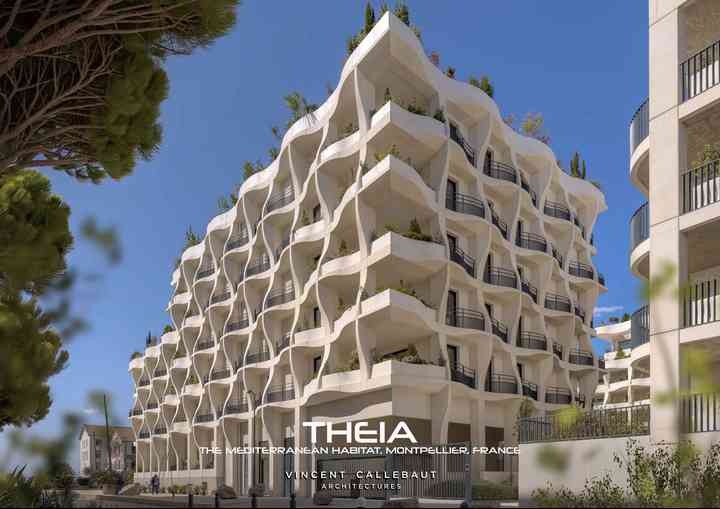
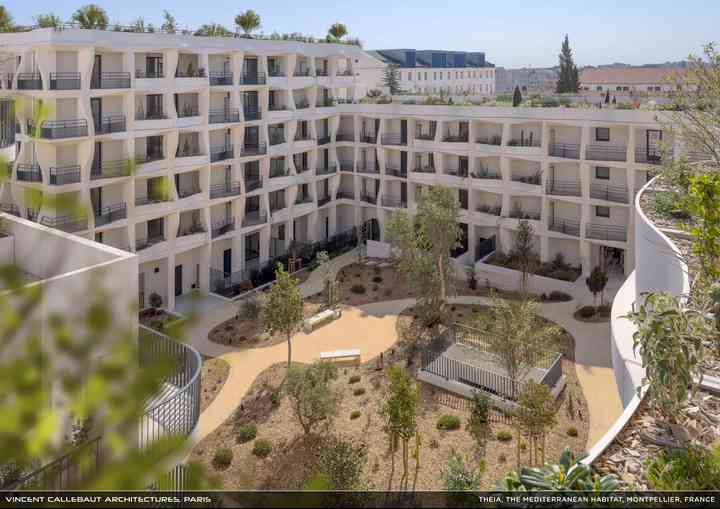
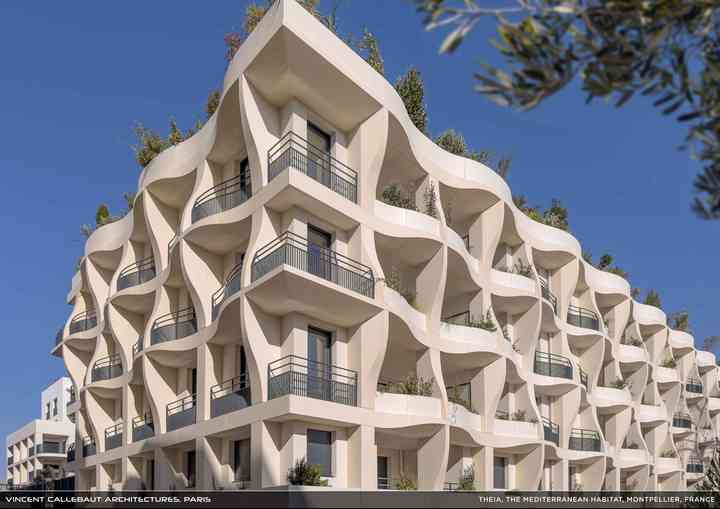
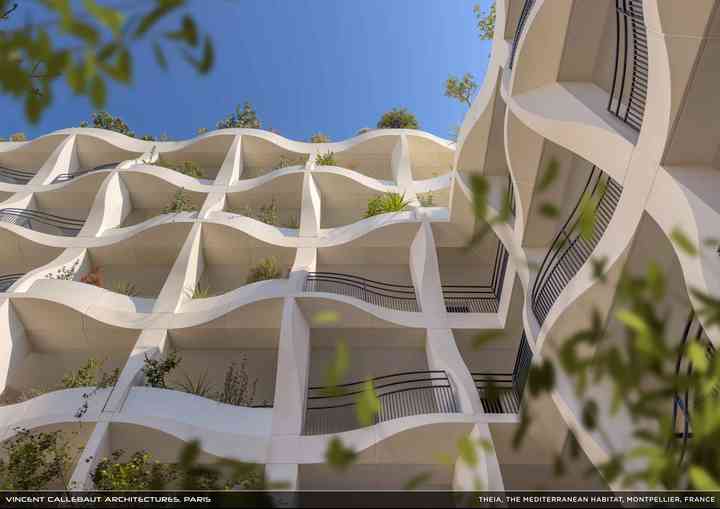
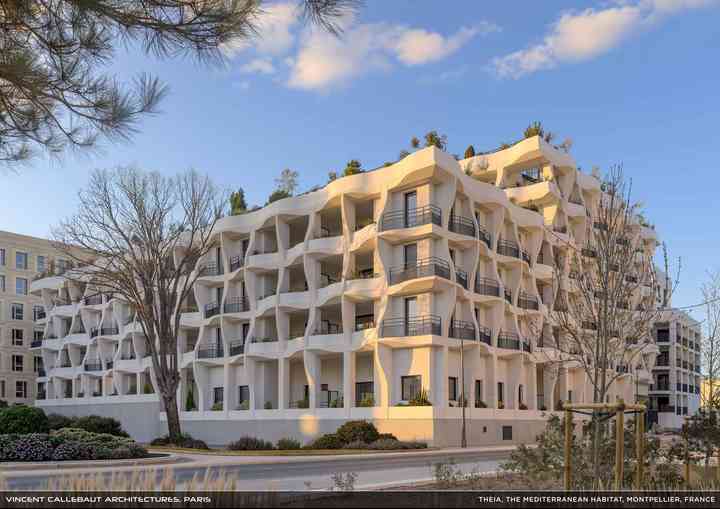
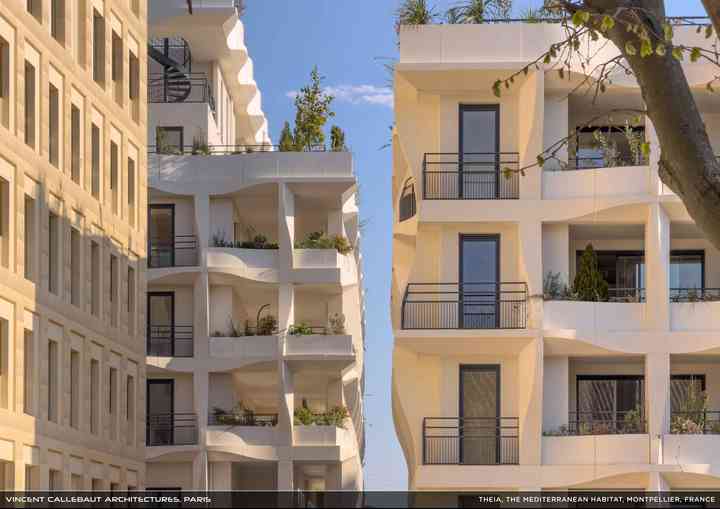
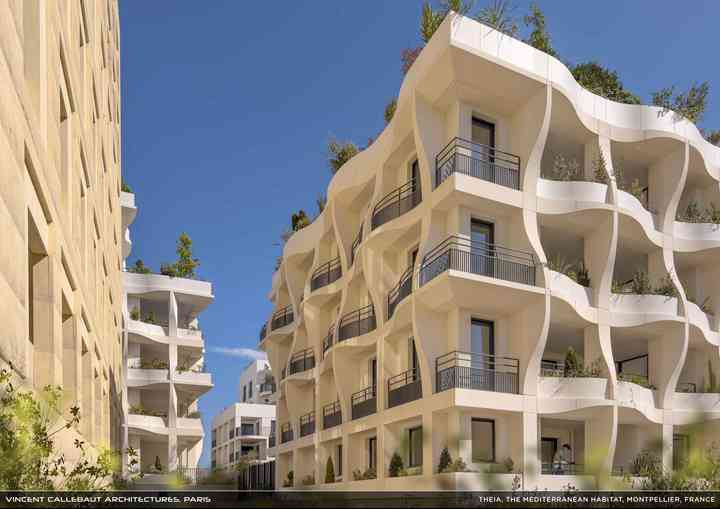
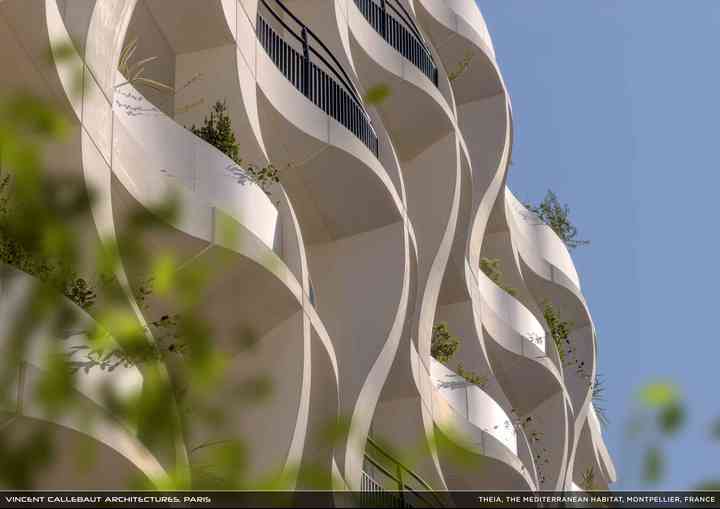
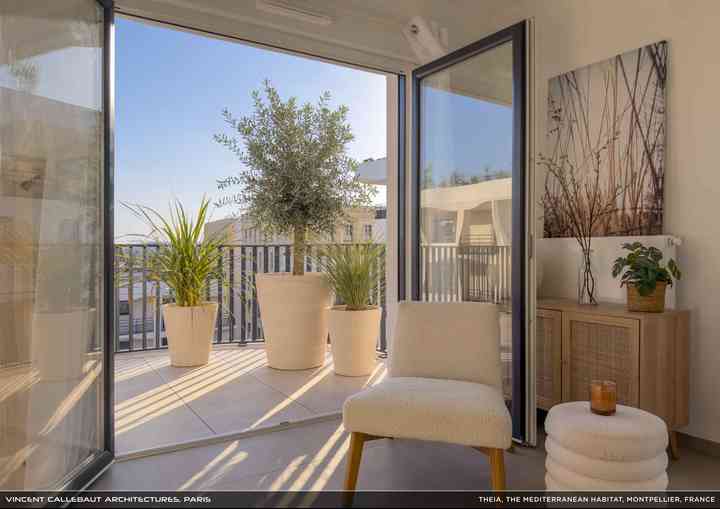
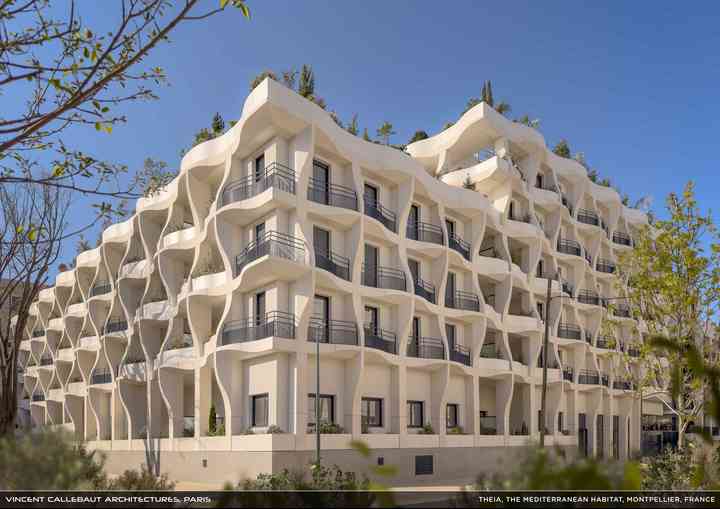
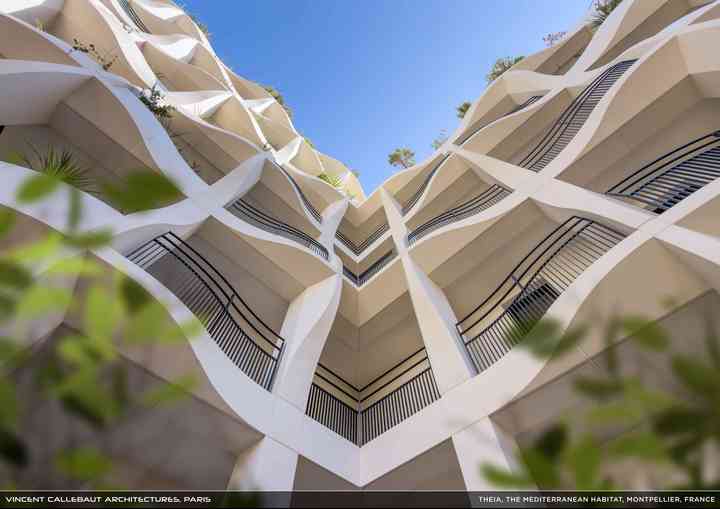
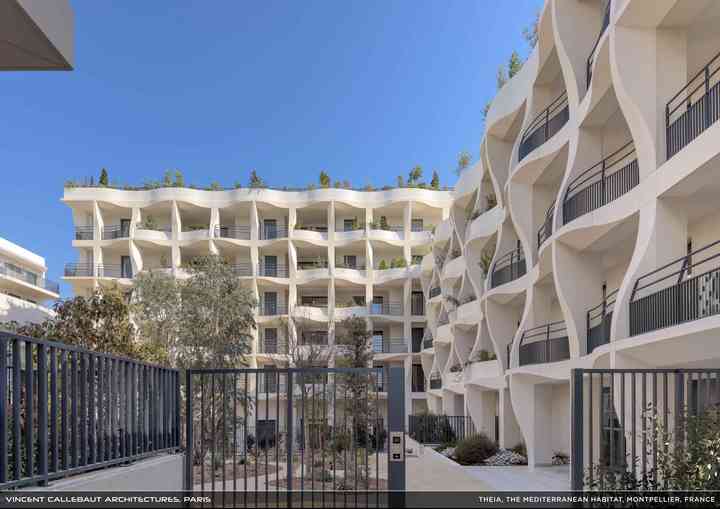
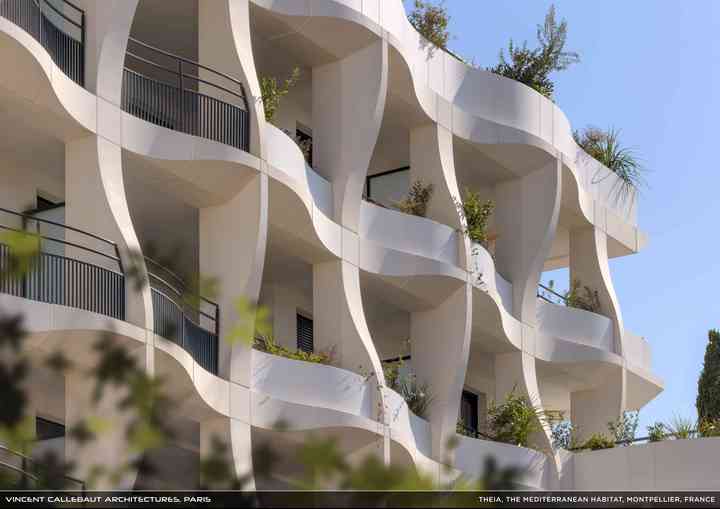
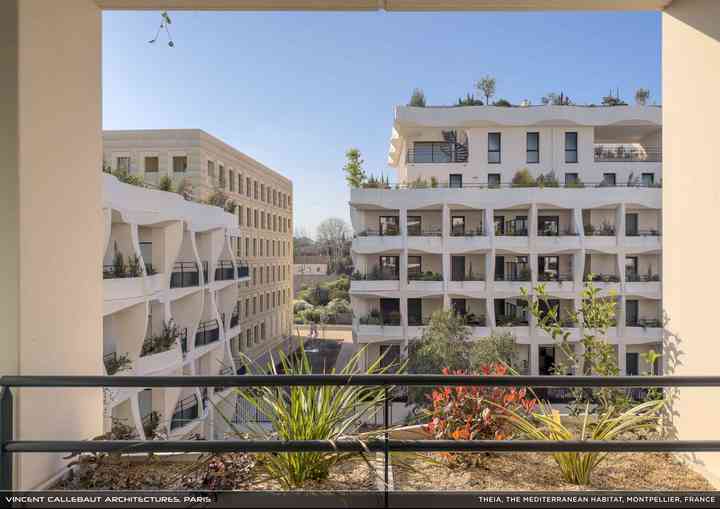
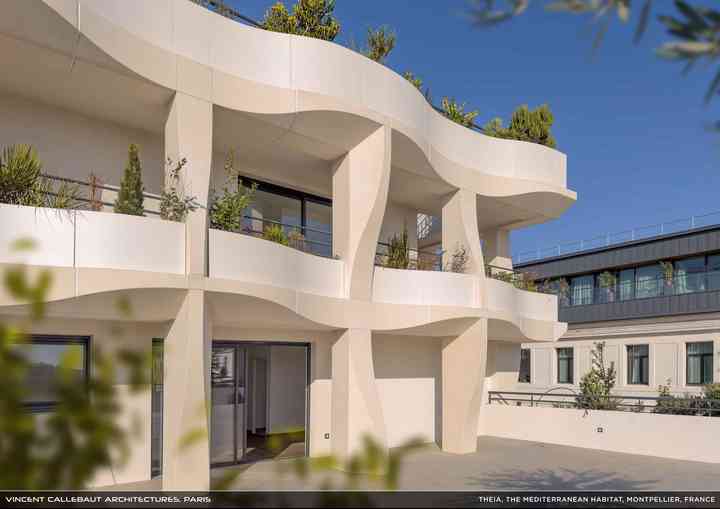
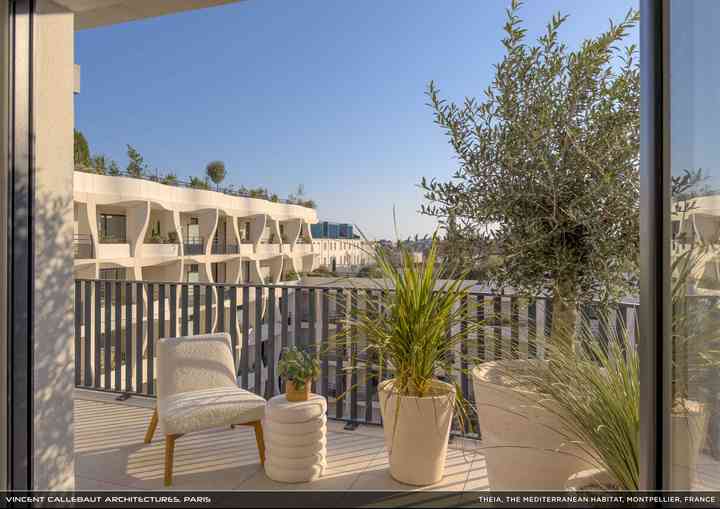
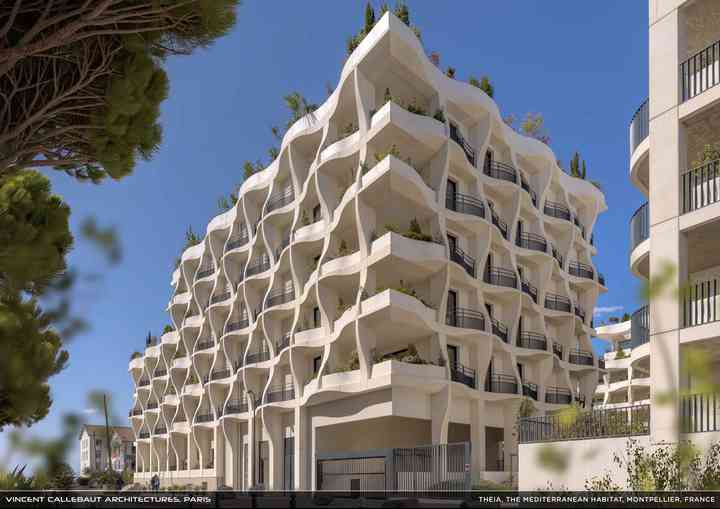
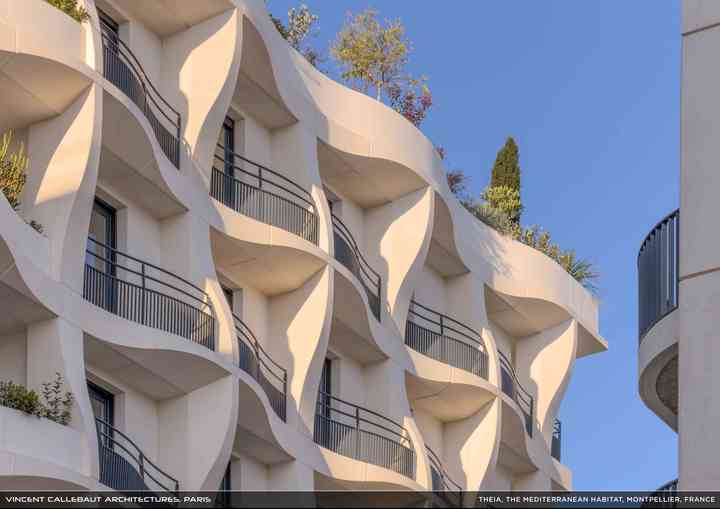
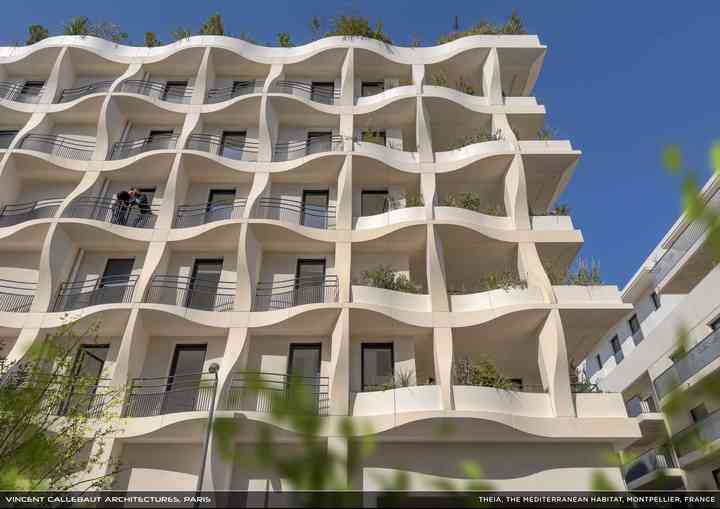
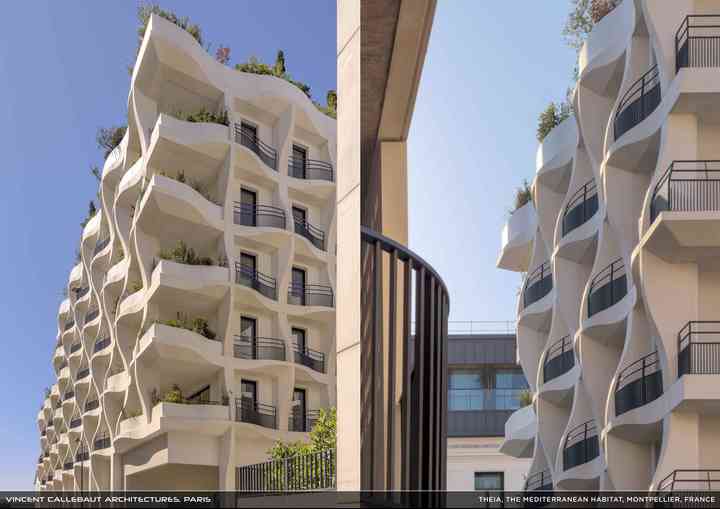
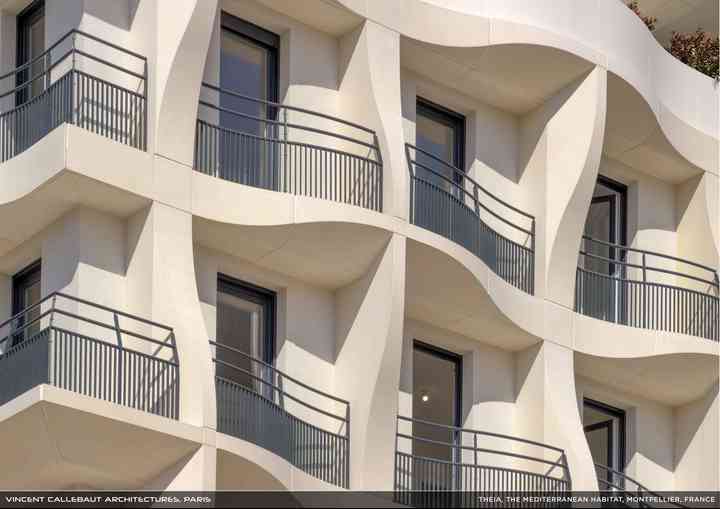
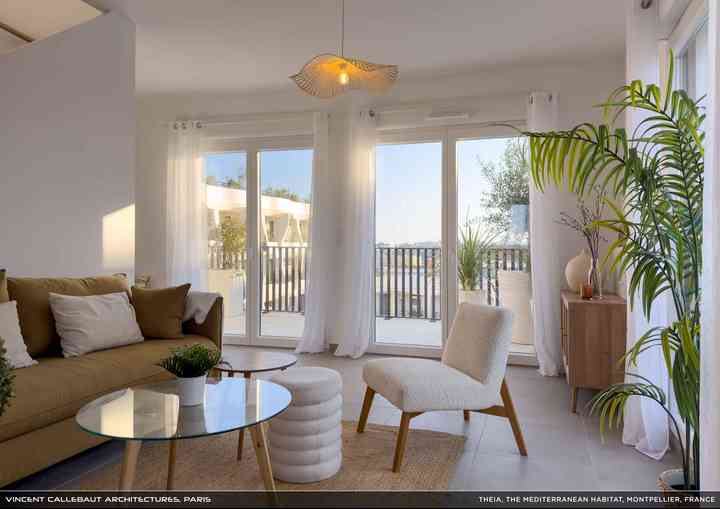
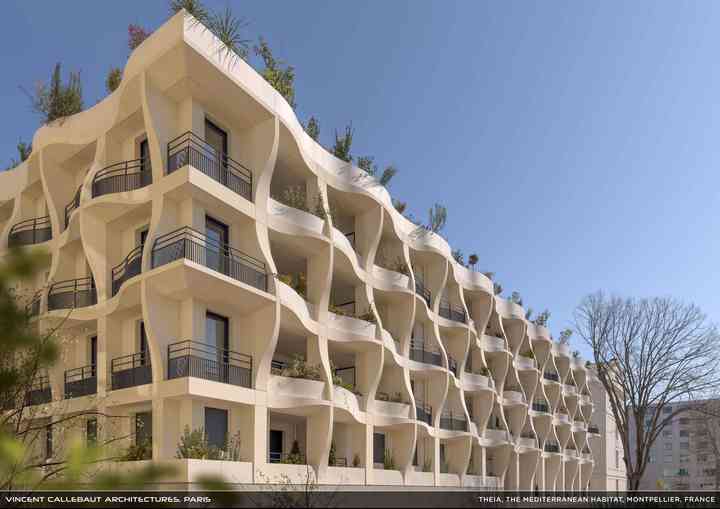
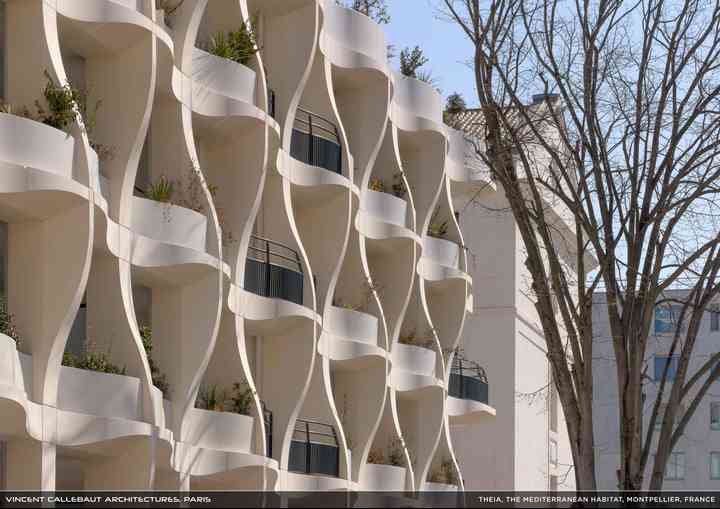
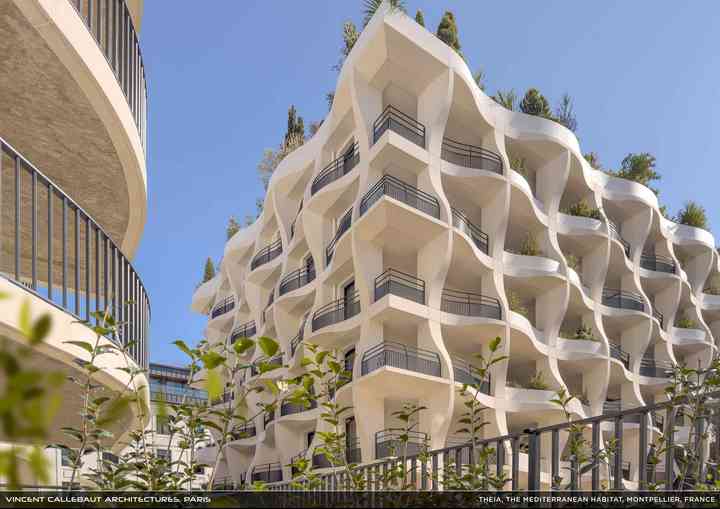
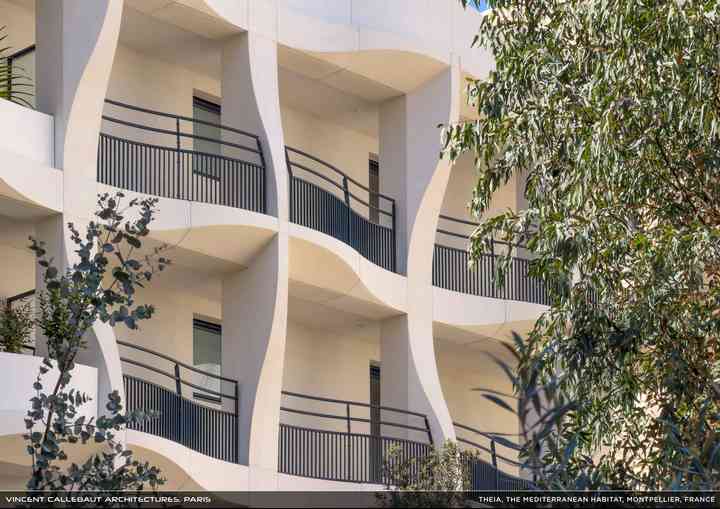
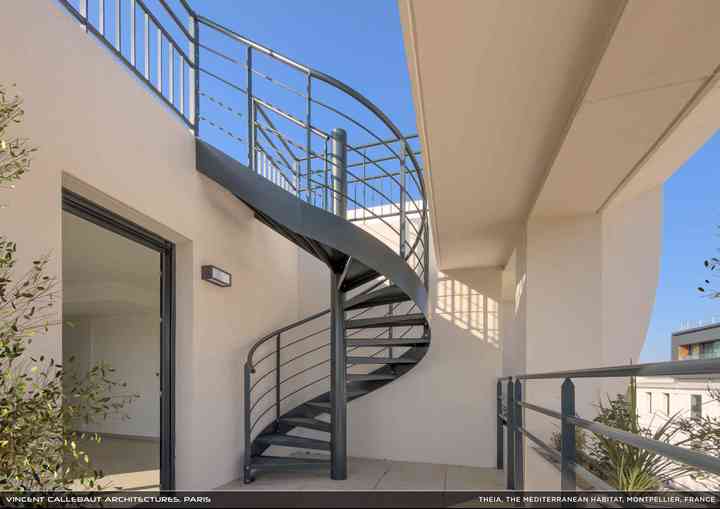
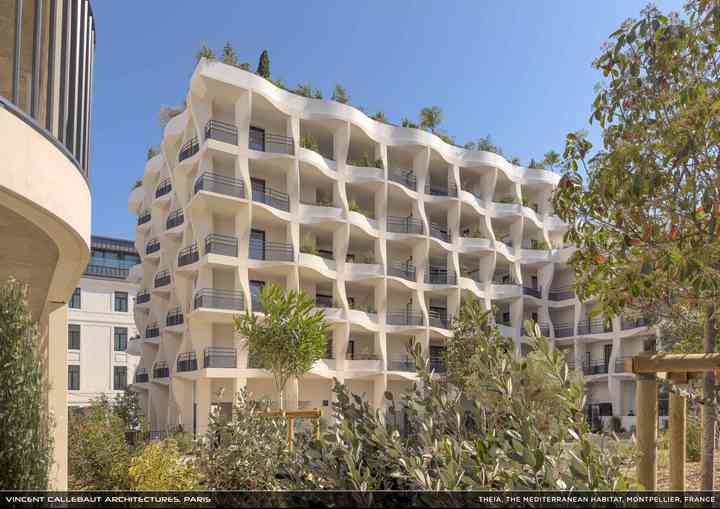
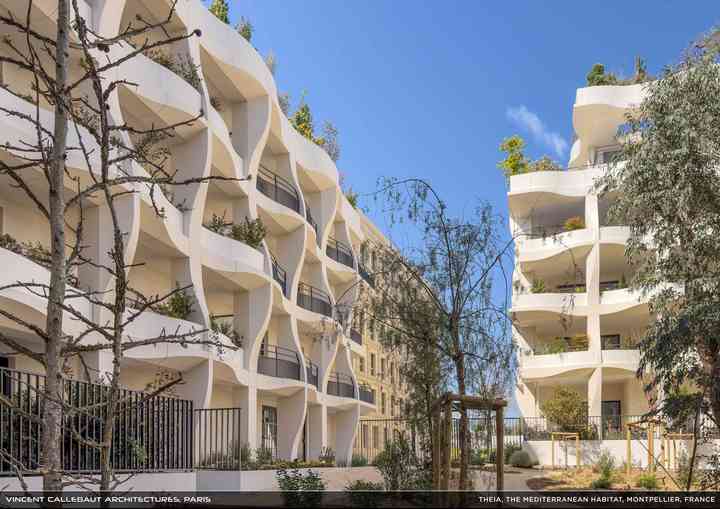
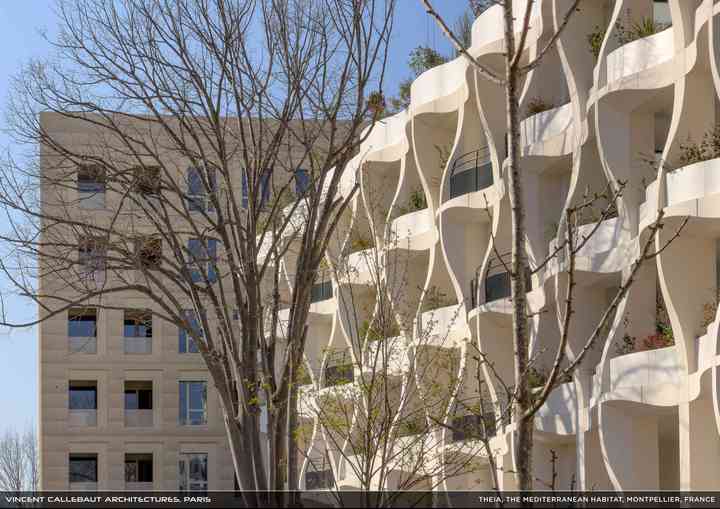
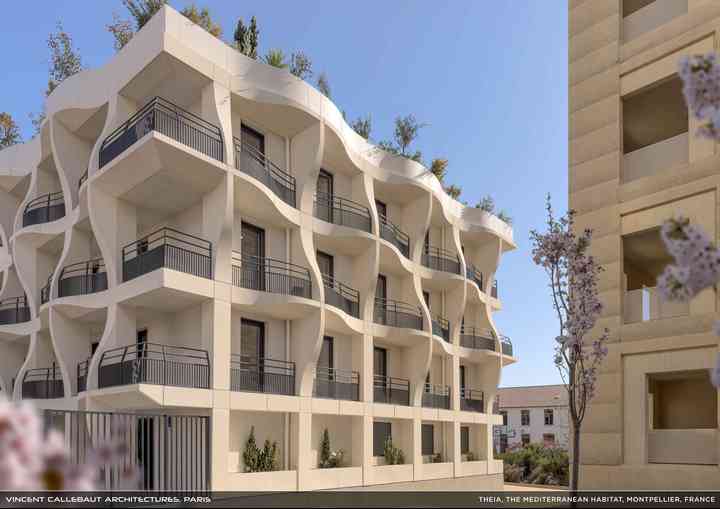
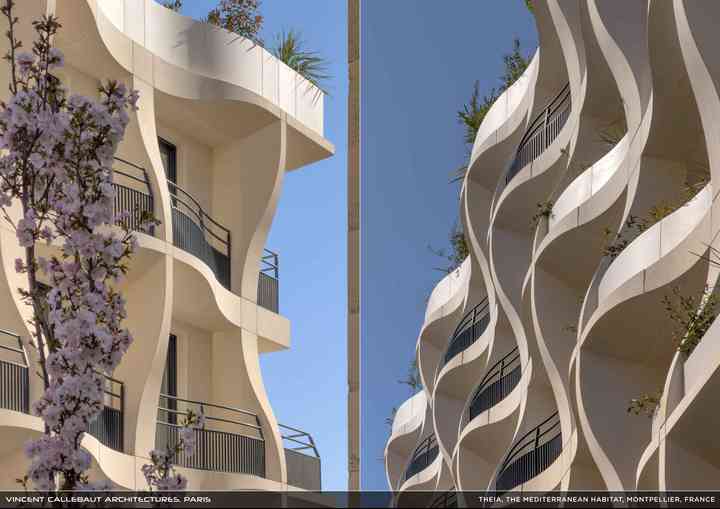
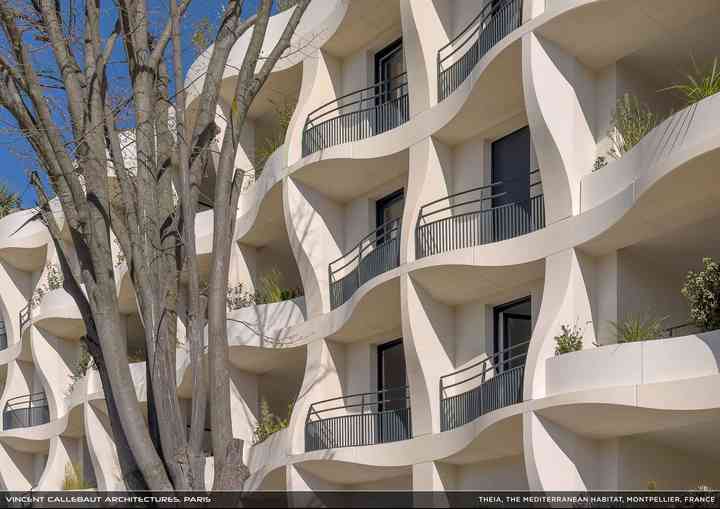
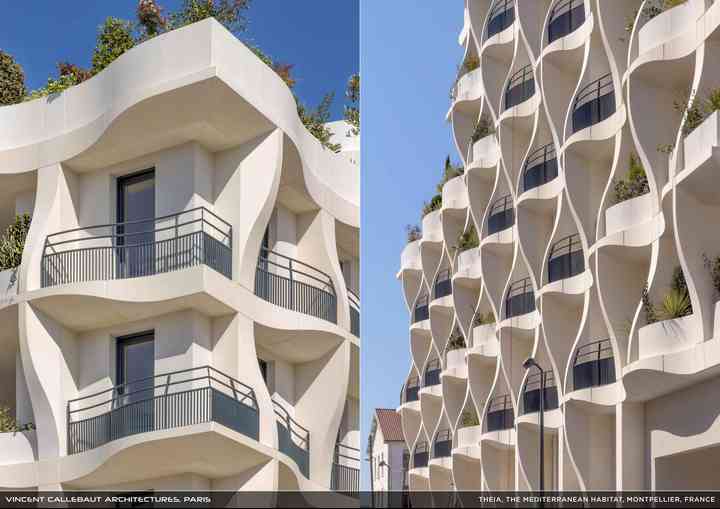
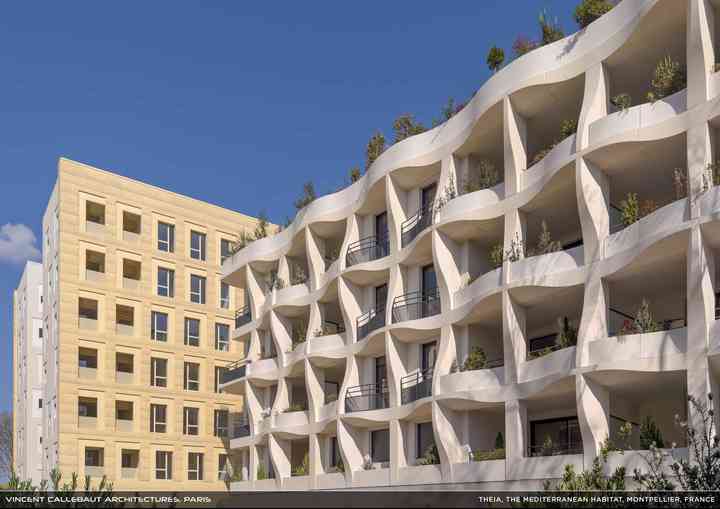
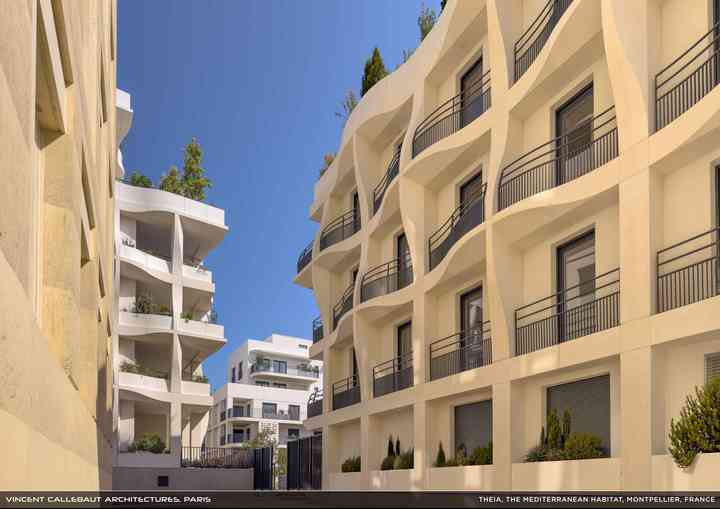
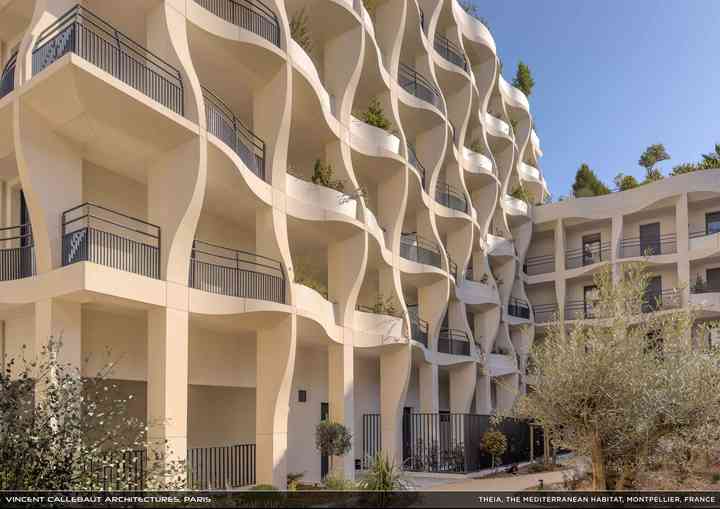
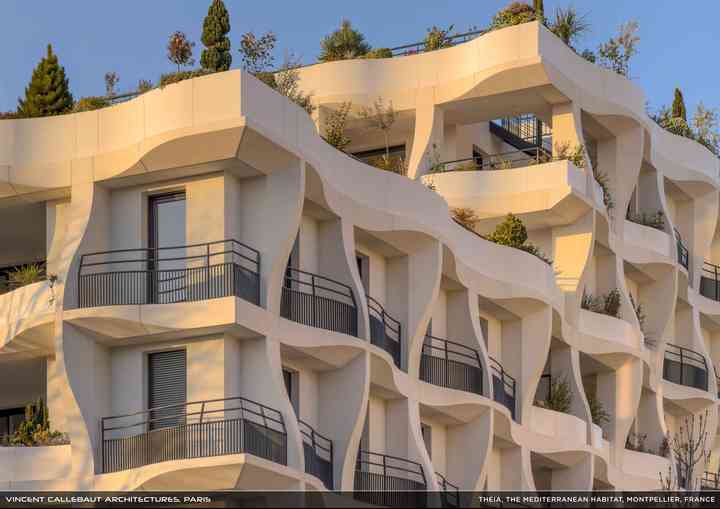
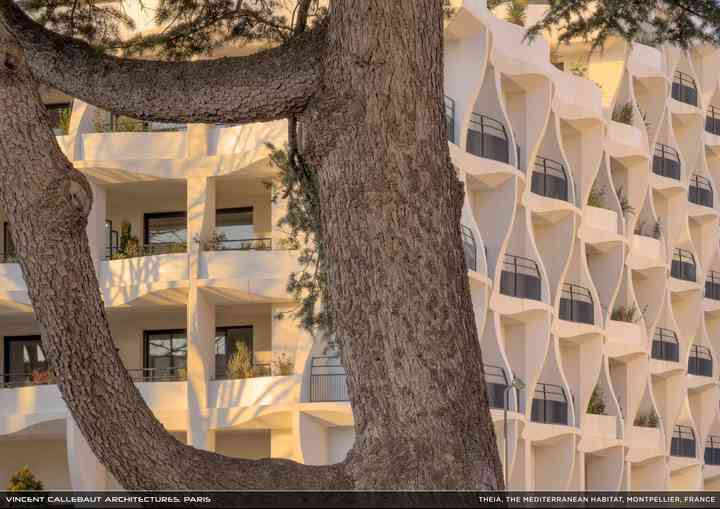
Delivered in March 2026 within the emblematic program “Jardins Secrets”, two residential buildings by Vincent Callebaut Architectures have now entered the city of Montpellier at a human scale, at the heart of the Cité Créative, on the historic site of the former École d’Application de l’Infanterie (EAI).
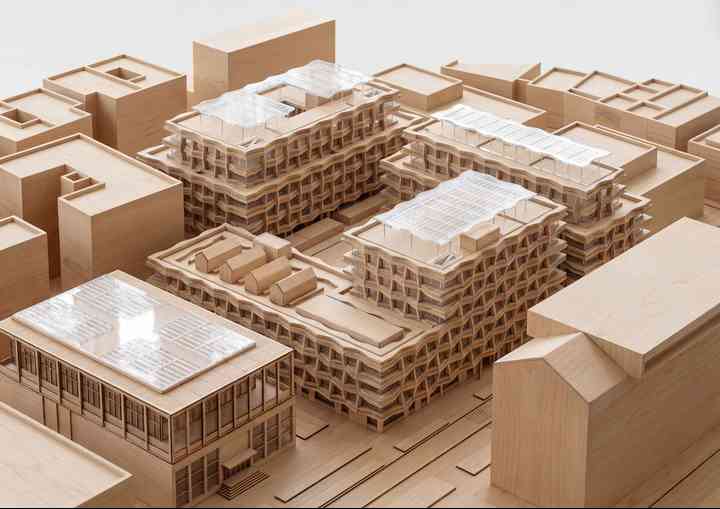
The project comprises Théia for Bouygues Immobilier (75 housing units, including 17 affordable ones, 5,364 m²) and Opale & Sens for Vestia Groupe (38 housing units, including 11 affordable ones, 2,845 m²), bringing together 113 homes designed in close alignment with the issues of RE2020, biodiversity and social mixity.
Awarded in the competition launched by the City of Montpellier in 2021, these two developments were later honored with the “Silver Pyramid for Global Quality” (La Pyramide d’Argent de la Qualité Globale), awarded by the Real Estate Developers Federation of Occitanie‑Mediterranean (Fédération des Promoteurs Immobiliers d’Occitanie‑Méditerranée) in autumn 2024.
The “Jardins Secrets” project responds to a dual challenge: respecting the memory of a former military site and inventing a new generation of dense, green and regenerative Mediterranean urbanity. Located less than one kilometer from the historical center of Montpellier’s Ecusson as the crow flies, it integrates seamlessly into the city’s suburbs, engaging in dialogue with the refined, orderly neighboring heritage architectures, while asserting a resolutely organic language.
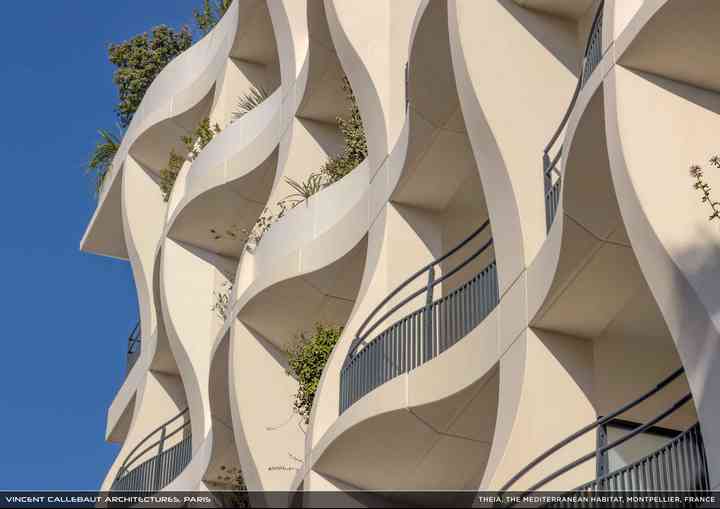
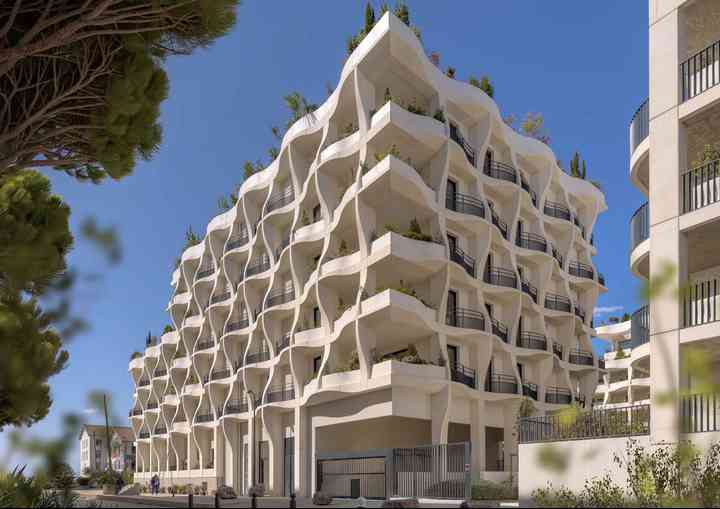
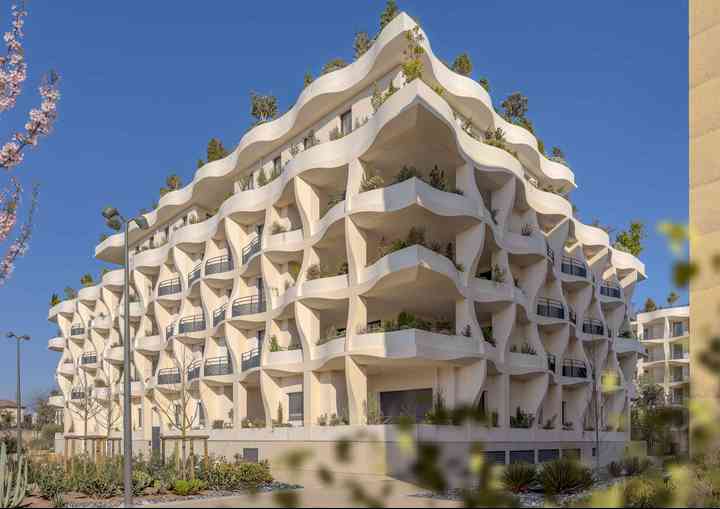
Between Art Nouveau and contemporary biomimicry, “Jardins Secrets” calls on Victor Horta, Antonio Gaudí and Émile Gallé to reactivate a tradition of ornament, this time placed at the service of climate and nature. The façades of Théia and Opale & Sens unfold like architectural shells, true exoskeletons delicately shaped by light and wind. These urban shells alternate between protective envelope and porous structure, filtering the sun, channeling air currents and offering the inhabitants a gentle, stabilised microclimate.
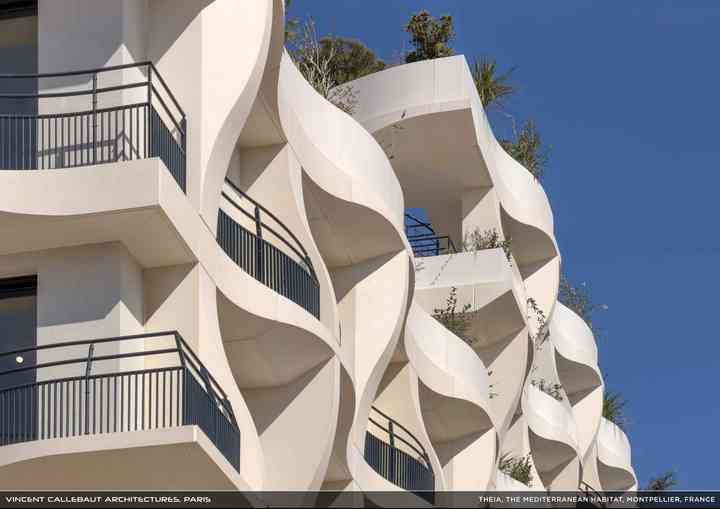
These mineral laces, entirely composed of convex and concave curves, behave like finely bisequed moucharabiehs, where waves sculpt the shade and set the light in motion. They optimise thermal inertia, solar protection and natural ventilation, while recalling that the right angle does not exist in nature and that architecture can conform to its fluid, generous forms.
This “Art Nouveau 2.0” writing expresses a vision: an architecture that is sensitive, performative and anchored in the Genius Loci, where “form follows climate”, parametrized according to the sun’s path and the prevailing wind axis. Here, the shell becomes a living model: an intelligent envelope, both poetic and rational, protecting the inhabitants like a natural habitat, while opening up to life and the Mediterranean context, much like a conch catching the sunlight, the breath of the sea and the murmur of the wind.
At the heart of the Cité Créative, “Jardins Secrets” participates in a continuous landscape with the neighbouring Parc Montcalm, forming an ecological corridor where built and vegetated spaces interact in permanence.
The project puts into practice:
• rainwater harvesting and greywater recycling for the irrigation of suspended gardens in a closed loop;
• a low‑carbon structure combined with high-performance thermal insulation;
• dense vegetation inspired by Mediterranean garrigue, creating an urban cool island through evapotranspiration and a sanctuary for local fauna and endemic flora.
The two buildings rely on shared renewable energy sources: connection to the district biomass boiler and installation of photovoltaic panels on the roofs, to maintain very low energy consumption at the level of the eco‑neighbourhood, in line with current performance standards.
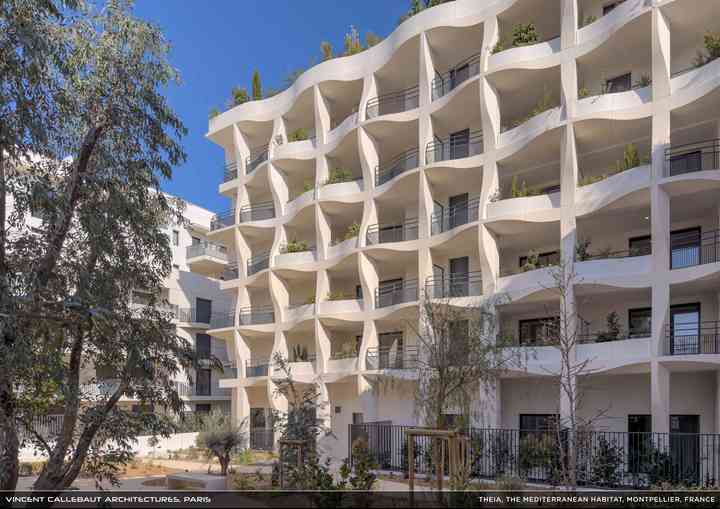
The 113 housing units (75 at Théia, 38 at Opale & Sens) gather around a large ground‑floor courtyard in open soil, a true vegetal sponge penetrated by trees rooted directly in the earth. This device combats soil sealing and rainwater runoff, at the same time reinforcing the thermal comfort of the ensemble.
The project articulates with the neighbourhood through:
• public pedestrian walkways connecting the Cité Créative;
• shaded private alleys and vegetated patios optimising summer comfort;
• ground‑floor levels raised by one metre (at the request of the chief urban planner) to preserve the privacy of residents while respecting the height of preserved heritage buildings.
Developed for Bouygues Immobilier, Théia occupies an “L”‑shaped massing in R+5 along rue Frida Kahlo (east) and in R+3 along the lane leading to the future, rehabilitated cinema “Le Cocon” (south).
The apartments, from T2 to T5, are cross‑ventilated or multi‑orientated, with two key typological devices:
• Deep loggias of 3.5 m, overlooking the heart of the plot and the skyline, which extend the living room as a “bonus room”, with privacy ensured by curved raised planters;
• Haussmann‑style balconies for the bedrooms, with curved wrought‑iron railings.
The roofs are developed as accessible terraces, offering panoramic views over the Montpellier landscape, while the outer corner of the “L” faces the arrival of the recently delivered tram line 5.
To preserve the open soil of the central garden, the shared parking, naturally ventilated by a large central patio, is contained beneath the buildings, while soft mobility is enhanced by well‑designed bicycle rooms on the ground floor and a basement car park.
For Vestia Groupe, Opale & Sens rises to R+3, with a double‑top‑floor duplex at R+4/R+5 set back by 3.5 m around its entire perimeter, along allée Mila Racine.
The building’s core is pierced by a full‑height central patio, which provides:
• natural ventilation for the dwellings;
• a calm urban buffer hosting access to the lobbies and the bicycle rooms.
The façades alternate between:
• vegetated loggias for the living rooms, facing the heart of the plot and the angles;
• Haussmann‑style balconies for the bedrooms, facing the street.
The ground‑floor apartments benefit from private elevated gardens, while continuous balconies draw sweeping waves along the more intensively planted façade facing the garden, strengthening the efficiency of an urban “cool island”.
At the heart of the Cité Créative, “Jardins Secrets” embodies a new generation of resolutely regenerative urbanity: dense yet porous housing, community gardens in open soil, shaded alleys, attics and densely vegetated roof terraces, material and energy sobriety, and shared renewable energy.
Drawing on Mediterranean ecosystems, the project moves beyond simple sustainability to produce:
• social ties around shared spaces and communal gardens;
• the restoration of ecological cycles (water, energy, biodiversity);
• climate and landscape resilience adapted to contemporary challenges.
With “Jardins Secrets”, Art Nouveau finds a 2.0 expression, both poetic and deeply ecological. Théia and Opale & Sens embody a design philosophy where architecture draws inspiration from the living world to coexist with it, reconciling aesthetics, performance and well‑being within an affordable housing framework.
Architecture thus becomes a mediator between the inhabitant, the climate and nature, articulating comfort, sobriety and landscape in a renewed constructive language.
© Vincent Callebaut Architectures, Paris
_______________________________________________________________________________________________
Livrées en mars 2026 au sein du programme emblématique « Jardins Secrets », deux résidences de Vincent Callebaut Architectures viennent d’entrer dans la ville de Montpellier, à l’échelle humaine et au cœur de la Cité Créative, sur le site historique de l’ancienne École d’Application de l’Infanterie (EAI).
Le projet comprend Théia pour Bouygues Immobilier (75 logements, dont 17 abordables, 5 364 m²) et Opale & Sens pour Vestia Groupe (38 logements, dont 11 abordables, 2 845 m²), réunissant 113 logements conçus au plus près des enjeux RE2020, biodiversité et mixité sociale.
Lauréats du concours lancé par la Ville de Montpellier en 2021, ces deux opérations ont été récompensées par « La Pyramide d’Argent de la Qualité Globale » décernée par la Fédération des Promoteurs Immobiliers d’Occitanie‑Méditerranée, à l’automne 2024.
Le projet « Jardins Secrets » répond à un double enjeu : respecter la mémoire d’un site historique militaire et inventer une nouvelle génération d’urbanité méditerranéenne, dense, verte et régénérative. Situé à moins d’un kilomètre à vol d’oiseau du centre‑historique de l’Ecusson, il s’inscrit sans rupture dans les faubourgs de Montpellier, en dialoguant avec les architectures patrimoniales voisines, rationalisées et ordonnancées, tout en affirmant une écriture résolument organique.
Entre Art Nouveau et biomimétisme contemporain, « Jardins Secrets » convoque Victor Horta, Antonio Gaudí et Émile Gallé pour réactiver une tradition de l’ornement, cette fois mis au service du climat et de la nature. Les façades de Théia et Opale & Sens se déploient comme des coquillages architecturaux, véritables exosquelettes délicatement façonnés par la lumière et le vent. Ces coquillages urbains alternent entre enveloppe protectrice et structure poreuse, filtrant le soleil, guidant les courants d’air et offrant aux habitants un microclimat apaisé.
Ces dentelles minérales, entièrement constituées de courbes convexes et concaves, se comportent comme des moucharabiehs géants finement biseautés, où les vagues sculptent l’ombre et font danser la lumière. Elles optimisent l’inertie thermique, les protections solaires et la ventilation naturelle, tout en rappelant que l’angle droit n’existe pas dans la nature et que l’architecture peut se conformer à ses formes fluides et généreuses.
Cette écriture « Art Nouveau 2.0 » traduit une vision : une architecture sensible, performative et ancrée dans le Genius Loci, où la forme suit le climat, paramétrée selon la course du soleil et l’axe des vents dominants. Ici, le coquillage devient un modèle vivant : une enveloppe intelligente, à la fois poétique et rationnelle, qui protège les habitants comme un habitat naturel, tout en s’ouvrant au vivant et au contexte méditerranéen, comme une conque accueillant la lumière, le souffle de la mer et le murmure du vent.
Au cœur de la Cité Créative, « Jardins Secrets » s’inscrit dans une continuité paysagère avec le Parc Montcalm voisin, formant un corridor écologique où bâti et végétal dialoguent en permanence.
Le projet met en œuvre :
• récupération des eaux pluviales et recyclage des eaux grises pour l’irrigation en boucle des jardins suspendus ;
• une structure bas carbone associée à une isolation thermique haute performance;
• une végétalisation dense inspirée de la garrigue méditerranéenne, créant un écran de fraîcheur urbain par évapotranspiration et un écrin de biodiversité pour la faune et la flore endémique.
Les deux bâtiments s’appuient sur des sources d’énergie renouvelable mutualisées : raccordement à la chaufferie biomasse du quartier et implantation de panneaux solaires photovoltaïques sur les toitures, afin de maintenir une très faible consommation d’énergie à l’échelle de l’écoquartier, en conformité avec les standards de performance actuels.
Les 113 logements (75 à Théia, 38 à Opale & Sens) s’organisent autour d’un grand cœur d’îlot en pleine terre, véritable éponge végétale traversée par des arbres enracinés en pleine terre. Ce dispositif lutte contre l’artificialisation des sols et le ruissellement des eaux pluviales, tout en renforçant le confort thermique de l’ensemble.
Le projet s’articule avec le quartier via :
• des allées piétonnes publiques reliant la Cité Créative ;
• des venelles privées ombragées et des patios végétalisés optimisant le confort d’été ;
• des rez‑de‑chaussée surélevés d’un mètre (à la demande de l’urbaniste en chef) pour préserver l’intimité des résidents tout en respectant la hauteur des bâtiments patrimoniaux préservés.
Développé pour Bouygues Immobilier, Théia occupe une volumétrie en « L », en R+5 le long de la rue Frida Kahlo (Est) et en R+3 le long de la venelle du futur cinéma réhabilité « Le Cocon » (Sud).
Les appartements, du T2 au T5, sont traversants ou multi‑orientés, avec deux dispositifs typologiques marqués :
• Loggias profondes de 3,5 m, vues sur le cœur d’îlot et la skyline, qui prolongent le séjour comme une « pièce bonus » dont l’intimité est assurée par des jardinières courbes ;
• Balcons de type haussmannien pour les chambres, avec garde‑corps cintrés en ferronnerie.
Les toitures aménagées en terrasses accessibles offrent des perspectives panoramiques sur le paysage montpelliérain, tandis que l’angle extérieur du bâtiment en « L » fait face à l’arrivée de la ligne 5 du tramway, récemment livrée.
Pour préserver la pleine terre du jardin central, le parking mutualisé, ventilé naturellement par un grand patio, est contraint sous les bâtiments, tandis que la mobilité douce est valorisée par des locaux vélos soignés en RDC et un stationnement en sous‑sol.
Pour Vestia Groupe, Opale & Sens s’élève en R+3, avec un double‑attique en R+4/R+5 en retrait de 3,5 m sur toute la périphérie, le long de l’allée Mila Racine.
Le cœur du bâtiment est transpercé par un patio central toute hauteur, qui assure :
• une ventilation naturelle des logements ;
• un sas urbain paisible accueillant les accès aux halls d’entrée et aux locaux vélos.
Les façades alternent :
• Loggias végétalisées pour les séjours, face au cœur d’îlot et aux angles ;
• Balcons haussmanniens pour les chambres, côté rue.
Les appartements du rez‑de‑chaussée bénéficient de jardins privatifs en surplomb, tandis que les balcons filants dessinent des vagues le long de la façade côté jardin plus intensément végétalisée, renforçant l’efficience d’un îlot de fraîcheur urbain.
Au cœur de la Cité Créative, « Jardins Secrets » incarne une nouvelle génération d’urbanité résolument régénérative : résidences denses mais poreuses, jardins en pleine terre, venelles ombragées, attiques et toitures‑terrasses densément végétalisés, sobriété carbone et énergies renouvelables mutualisées.
En s’inspirant des écosystèmes méditerranéens, le projet dépasse la simple durabilité pour produire :
• des liens de sociabilité autour des espaces communs et des jardins partagés ;
• le rétablissement des cycles écologiques (eau, énergie, biodiversité) ;
• une résilience climatique et paysagère adaptée aux défis contemporains.
Avec « Jardins Secrets », l’Art Nouveau trouve une expression 2.0, à la fois poétique et profondément écologique. Théia et Opale & Sens incarnent une philosophie de conception où l’architecture s’inspire du vivant pour mieux cohabiter avec lui, en réconciliant esthétique, performance et bien‑être dans un cadre de logement abordable.
L’architecture se fait ainsi médiatrice entre l’habitant, le climat et la nature, articulant confort, sobriété et paysage en une langue constructive renouvelée.
© Vincent Callebaut Architectures, Paris
Copyright : Vincent Callebaut Architectures
All rights reserved.